Over the years, while reading manuals, technical notes, and listening to my own Philips LHH1000, I began to see it less as a product and more as part of a moment in digital audio. Built in the late 1980s, it reflects how Philips approached compact disc replay after the format had settled, drawing directly on ideas from the professional LHH2000.
In this blog, I share how my understanding of the LHH1000 grew over time, focusing on the design choices around mechanics, timing, and system layout, and how those choices shape the way it behaves and sounds in everyday listening.
By the late 1980s, the Compact Disc was no longer an experiment. The pioneering phase was over. The question was no longer about whether digital audio would survive, but about how its architecture could be refined.
The first generation of CD players had secured acceptance for the format. The focus now shifted toward stability, lower noise, and greater mechanical precision. In a market that was maturing quickly, careful refinement mattered more than bold experimentation.
For Philips, this moment was layered and complex. As co-inventor of the CD standard, the company had built the multibit architecture into the foundation of the format. Yet internally, development was already moving toward highly integrated Bitstream solutions. These promised lower costs and efficient large-scale VLSI production.
When I look at the LHH1000 today, I see a product shaped by that quiet tension between continuity and change.
Understanding the Philips LHH1000
What is the Philips LHH1000 in practical terms?
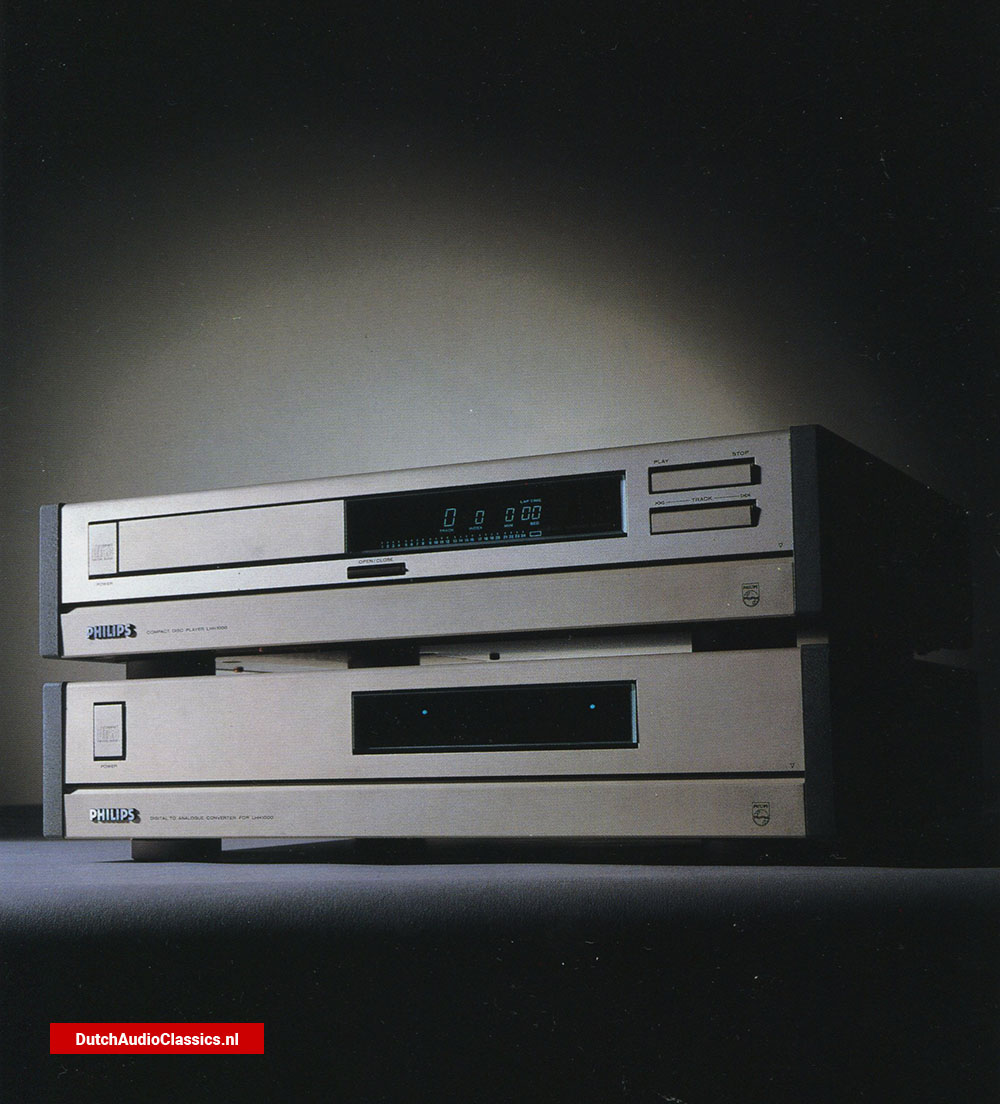
The LHH1000 is a high-end CD playback system from the late 1980s, consisting of a separate transport, D/A converter, and control unit. It was developed by Philips using design principles drawn from its professional broadcast and studio equipment.
Why is the LHH1000 discussed as part of a broader development path?
The system can be understood as a domestic translation of the Philips LHH2000 professional compact disc player system. Many of its structural and technical choices reflect an effort to carry professional discipline into the living room without simplifying the underlying approach.
How should the listening impressions in this text be read?
They are based on long-term personal listening and comparison with documented descriptions from the period. The observations are meant to connect audible behaviour to known design choices, not to rank or evaluate the system against others.
Philips at a Strategic Crossroads
Around 1988, Philips stood at a strategic crossroads. It was a leader in conventional multibit DAC design. At the same time, global competition demanded simplification, integration, and tighter cost control.
Japanese high-end brands were presenting multi-box CD systems that stressed mechanical precision and separate power supplies. Their message was clear: physical separation and engineering discipline equalled sonic authority. Meanwhile, Philips engineers were advancing Bitstream technology in-house. With fewer components, it could deliver competitive measurements and fit more naturally into mass production.
In this context, the LHH1000 can be seen as a confident statement. It was not built to generate high sales volumes. Its purpose was to confirm the strength and relevance of the established multibit approach.
The project likely carried internal weight as well. It showed that the classic ladder DAC architecture had not yet reached its limits. Careful component selection and structural stability could still stand alongside the promise of integration and simplification.
Derived from the Studio
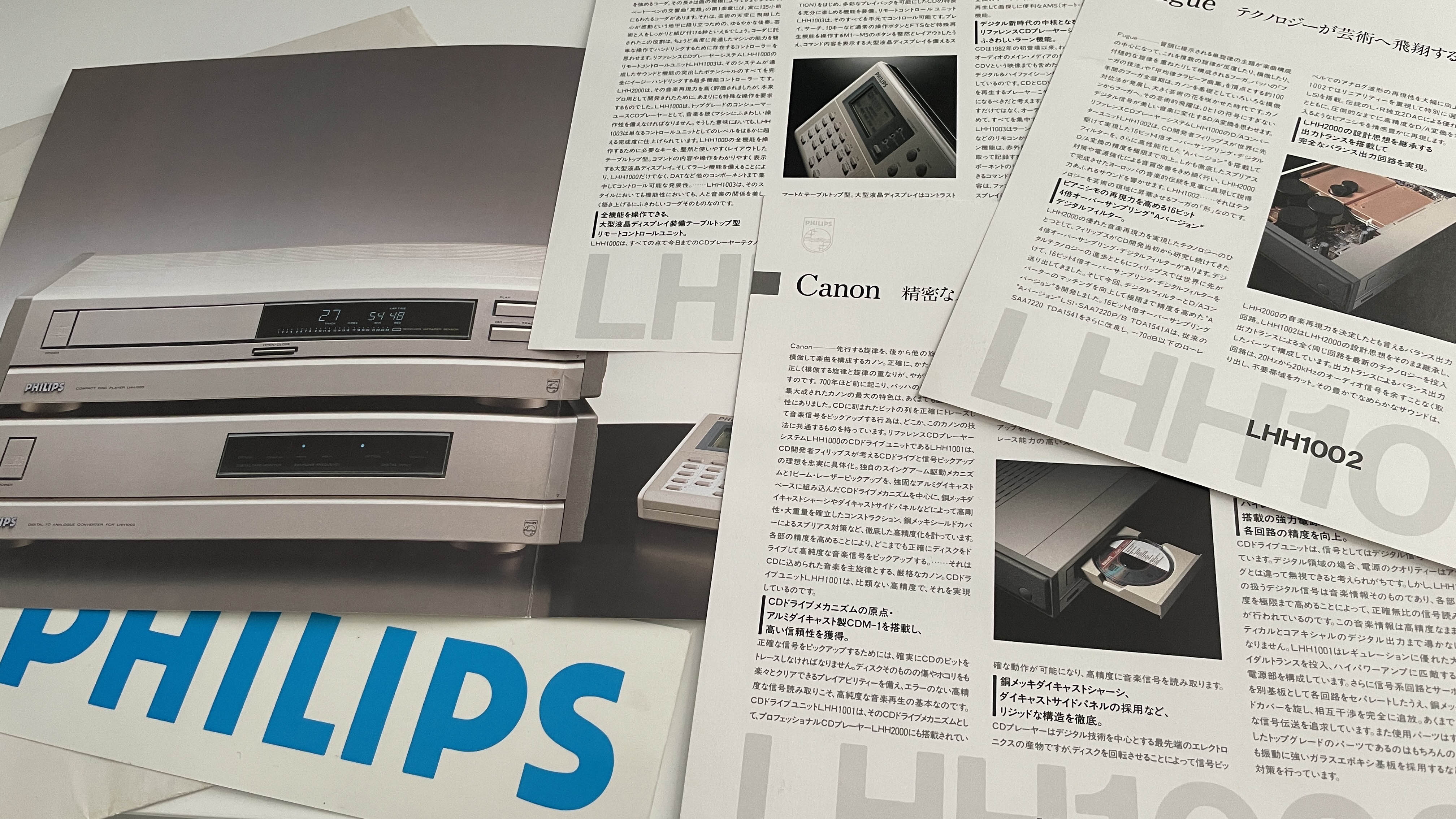
The LHH1000 did not follow Philips’ usual consumer logic. It was, in essence, a domesticated version of the professional philosophy behind the Philips LHH2000.
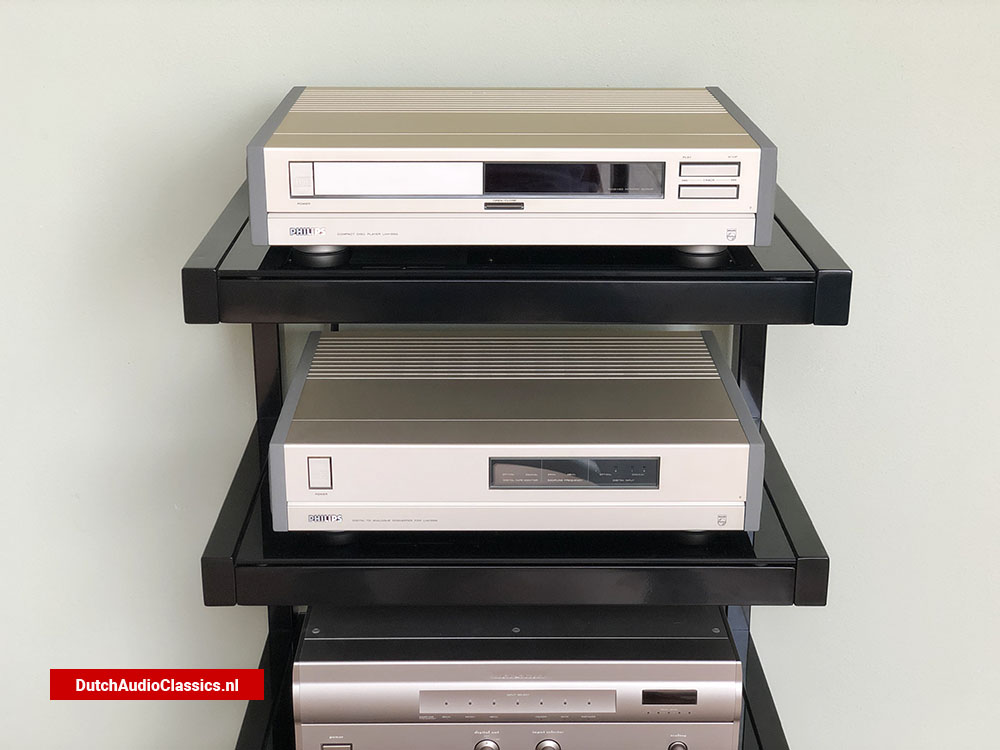
Its layout was modular. The transport, D/A converter, and control sections were physically separated. This was not styling for its own sake. It was a deliberate technical decision.
The transport sat in its own enclosure with its own power supply. The DAC section was electrically isolated from the mechanical parts. Control circuitry and signal processing were carefully kept apart.
This reflects a broadcast mindset. In professional environments, predictability is critical. Problems are not meant to be corrected later. They are meant to be prevented from occurring at all.
As a result, the LHH1000 was more than a CD player. It was a system built around architectural discipline.
The Technical Core
At the heart of the system was the proven Philips CDM-1 transport. Its swing-arm design, built on a solid metal frame with a glass lens assembly, was widely respected for mechanical durability.
The idea behind it was simple. Keep the moving mass low. Ensure stable radial tracking. Build everything on a rigid foundation. Instead of lightweight plastic structures, the CDM-1 relied on mass and structural integrity.
For digital-to-analogue conversion, Philips selected the TDA1541A S1, the highest grade within that DAC family. This version was specified with tighter tolerances and lower deviation between its internal ladder resistors.
Digital filtering remained conservative. There were no radical new oversampling schemes. Instead, Philips refined the established 4x oversampling concept. The priority was predictability and linear performance.
In this configuration, Philips’ multibit philosophy reached its most mature expression. This was no longer a search for direction. It was optimisation. A careful polishing of an architecture that had already proven itself.
Soon after, Bitstream would become Philips’ strategic path forward. Seen from that perspective, the LHH1000 stands as the last full statement of the classic multibit ladder approach within the company.
Stability Before Correction
For me, what truly defines the LHH1000 is the philosophy that shapes it.
The design aims to minimise interaction between subsystems. Mechanical vibrations are isolated. Power supplies are divided and carefully managed. Digital and analogue grounds are kept strictly separate. Clock integrity is protected not by complex recalculation later in the chain, but by maintaining a calm and controlled signal path from the beginning.
The guiding idea seems clear: avoid instability rather than fix it afterwards.
This approach contrasts sharply with the growing influence of DSP in the late 1980s. Increasingly, designers relied on processing power to compensate for imperfections. Jitter could be reduced by re-clocking. Deviations could be corrected digitally.
The LHH1000 chooses the opposite direction. It favours mass over miniaturisation. Separation over integration. Prevention over correction.
In that sense, it represents a belief in physical order as the primary safeguard of performance.
Positioning in a Changing Market
The competitive pressure came largely from Japan. High-end brands promoted multi-box systems with heavy transports, discrete power supplies, and visible engineering seriousness. At the same time, Bitstream and 1-bit conversion became powerful marketing narratives. Fewer parts, lower production costs, and strong specifications. Compact chassis designs became easier to realise.
Inside Philips, the logic of integration was difficult to ignore. Economies of scale depended on it. The LHH1000 moved in the opposite direction. It increased physical complexity instead of reducing it. It strengthened an existing architecture rather than replacing it.
That is what makes its position so distinctive. It does not anticipate the next phase. It completes the current one.
I see it as a careful rounding off of an architectural idea, not an attempt to expand it further.
Historical Significance
In retrospect, I think the Philips LHH1000 was not a dramatic technological leap. It was a stabilising gesture.
It shows what first-generation CD architecture could achieve when cost reduction was not the dominant priority. When careful selection, physical separation, and structural mass guided the design.
For that reason, it stands as a historical artefact.
It is not visually extravagant. Nor is it conceptually radical. Its strength lies in consistency.
The deeper meaning of the LHH1000 may lie in its restraint. It refused to simplify too soon. It held on to a philosophy that still had room to mature.
In doing so, it marked the closing phase of Philips’ first digital era. A moment of concentration before the industry decisively embraced integration and scale.
Within that moment, I think the LHH1000 finds its value that still holds today. Not as a symbol of disruption, but as a carefully executed and disciplined conclusion.
This page explores the Philips LHH1000 as a late-1980s CD system, viewed through long-term research and personal listening, focusing on design choices and context.